Application Architecture
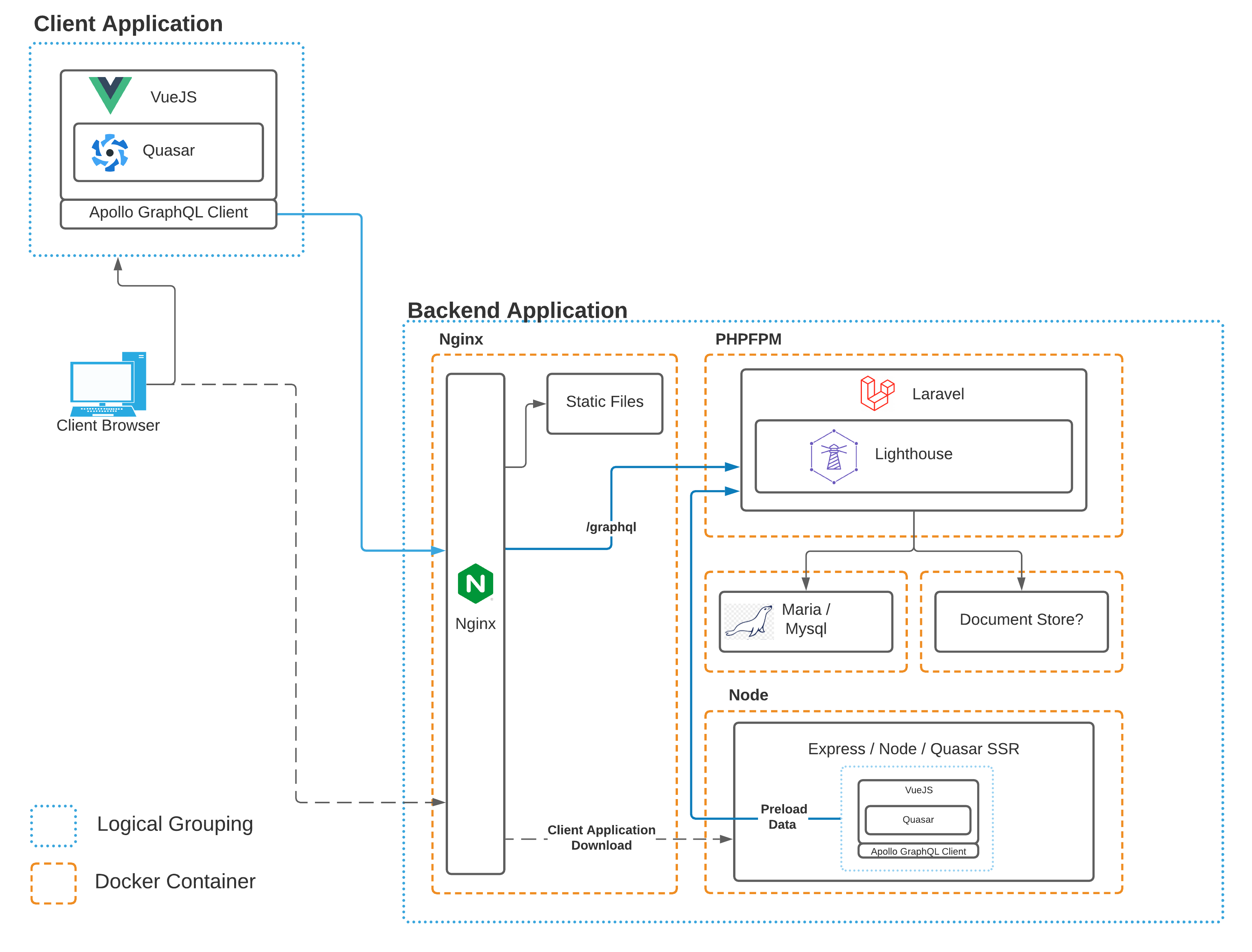
Containers
Pilcrow uses a multi-container docker architecture. Three primary containers serve the application:
- Proxy: An NGiNX container that proxies outside requests into the application.
- Application: A PHP-FPM container that provides the backend GraphQL API
- Database: A MySQL container that provides the relational DB
There are also a few other containers that only exist in the development environment.
- Client: A node container that builds the application and provides Hot-Module-Replacement (HMR)
- Docs: A development container for the documentation system.
- Test: A container to serve the Majestic interface for running Jest unit tests.
In a production environment, the application is compiled and served by the proxy container directly. The proxy container is the only public container in the stack. Requests for the /graphql or /graphiql (development mode only) are proxied to the application server. All other requests that are not for a static asset will return the compiled client's index.html.
Note: Our Lando development environment proxies client requests to a client container running quasar dev to allow for hot module replacement (HMR).
Server-Side Rendering
Future architectures may employ a Node container for server-side rendering (SSR) to improve initial page load performance. For right now, though, we've decided to defer implementing SSR and directly ship compiled assets via the proxy.
Application Server (API)


The backend API portion of the stack is a Laravel application with Lighthouse providing GraphQL server functionality. Laravel Sanctum provides authentication.
Client (Quasar/Vue)


The frontend client application is a Quasar/Vue application. Interaction with the backend API is via ApolloClient.